


Verifying a Chinese supplier is not about trust. It is about which claims can be checked cheaply and which cannot. Most buyers spend their diligence on the wrong things — a video of a shiny assembly line, a wall of framed certificates — and skip the three checks that would actually have caught the supplier that hurt them.
Below is a five-step sequence, in the order that costs you the least money to run and produces the most information. None of it requires you to fly to Guangdong.
Step 1 — Confirm the legal entity, not the brand
Every Chinese company has a business licence, and its details are public. Ask for a scan and read five fields, then verify them against the national credit registry rather than against a PDF the supplier sent you.
| Field on the licence | What you are checking |
|---|---|
| Unified social credit code | An 18-character code that identifies one specific legal entity. It should appear on the PI, the contract and the bank account name |
| Date of establishment | Consistency with the “14 years of experience” claim. A company registered three years ago can still have older roots, but ask which entity the older history belongs to |
| Registered capital | A rough signal of scale, not of quality. A very small figure on a company claiming container volume is worth a question |
| Business scope | Does it include manufacture, and does it include import/export rights? A trading scope with no manufacturing is a trader, whatever the website says |
| Registered address | Compare it to the address on the quotation. Same district is fine; a residential building or a virtual office address is not |
Two independent checks are free and take ten minutes. First, the National Enterprise Credit Information Publicity System at gsxt.gov.cn, where the licence details and any abnormal-operation records are published. Second, the customs credit platform, which shows whether the entity is registered for import/export and its credit rating — a factory that genuinely exports has a record there.
Step 2 — Read the certificates properly
Compliance paperwork is where the most confident claims and the least evidence meet. Each document type answers a different question, and some of them are declarations rather than tests.
| Document | What it actually proves | What to check before you accept it |
|---|---|---|
| CE marking | For LED bulbs this is normally a manufacturer’s self-declaration under the EMC and Low Voltage directives — not a certificate issued by a notified body | Ask for the declaration of conformity and the underlying EMC and LVD test reports. A CE “certificate” with no test report behind it proves nothing |
| EMC test report | Radiated and conducted emissions measured to a named standard | Issuing laboratory, report number, test date, the standard cited, and your exact model number listed inside the report |
| RoHS report | Restricted substances below threshold | Whether it covers six substances or ten (the newer phthalate additions), and whether the model list matches |
| ISO 9001 | A quality management system was audited at a specific site | Certificate number, certification body, validity date, and the scope wording — “design and manufacture of automotive lighting” is specific, “trade” is not |
| IATF 16949 | Automotive-sector quality management | This applies to automotive production sites. Many aftermarket bulb makers hold ISO 9001 instead, and claiming IATF without a certificate number is a red flag in itself |
| DOT / E-mark | Type-approval claims for road use | Which regulation, which approval number, and whether the “approval” belongs to the bulb or to a different product the company also sells |
Reports age. A 2019 test report on a model whose LED chip changed in 2023 is decoration. Ask for the report that covers the current bill of materials, and ask them to confirm in writing which chip and driver the report was tested with.
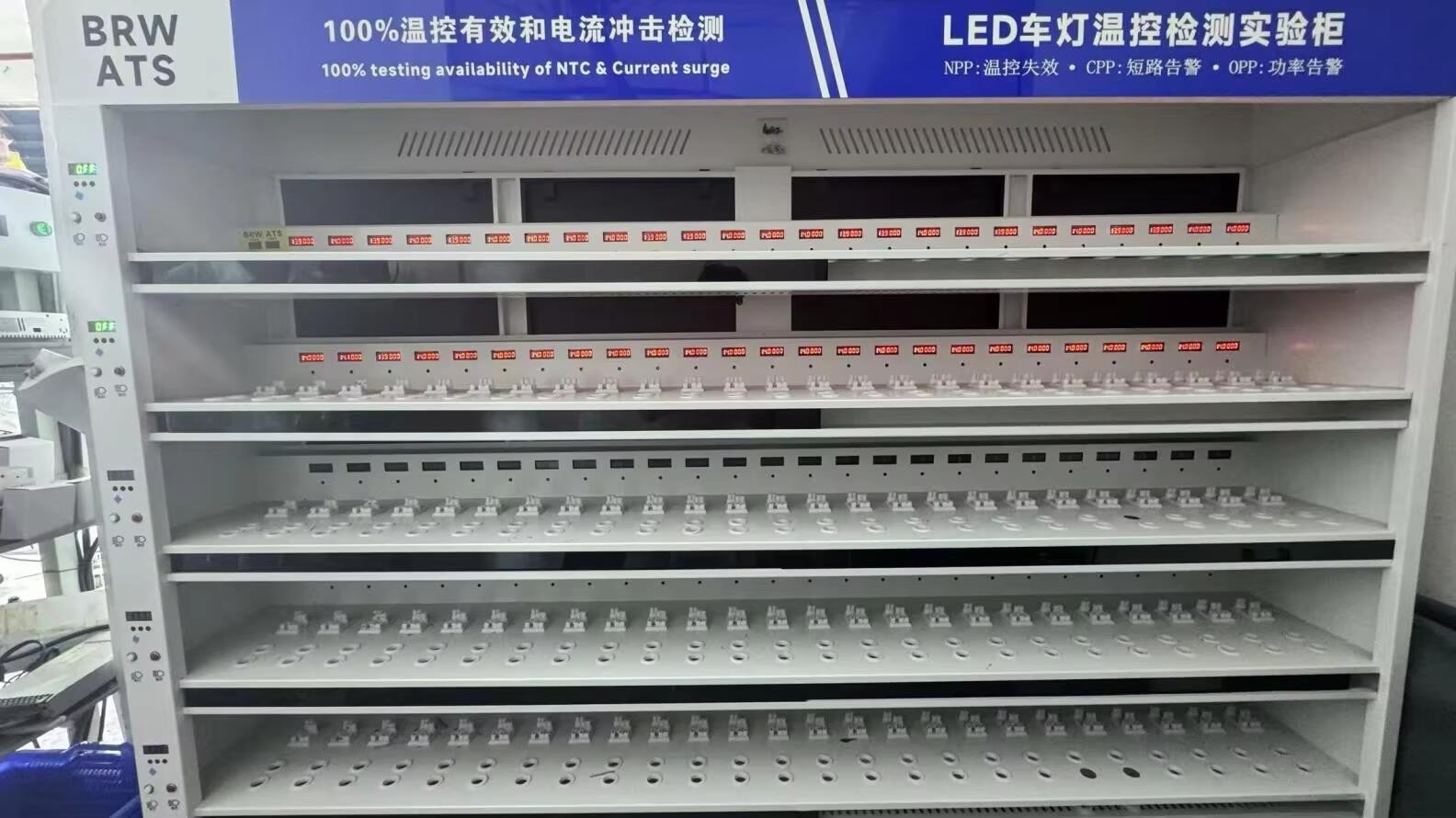
Step 3 — Run a video walkthrough that can actually fail
A recorded “factory tour” video is edited. A live video call where you choose the route is not. Give the supplier the route in advance, in writing, and watch what they are reluctant to pan the camera towards.
Ask them to walk, in one continuous call, through: incoming material inspection, the SMT line, driver assembly, the ageing or burn-in rack, the photometric or integrating-sphere check, and the packing area. Then ask four specific questions while the camera is still rolling:
- How long do units sit on the ageing rack, and is the timer visible on the rack?
- Can you show me today’s work order for my model, with the date and quantity on it?
- What percentage of units are pulled for the photometric check, and what happens to the ones that fail?
- Where is the reject bin, and what is in it right now?
The answers that should worry you: nobody on the line can state the burn-in duration; the work order is “not available”; the reject bin is empty because “we never have rejects”; or the SMT line is not running and the camera stays on the showroom.
Step 4 — Put an independent inspection between you and the balance payment
For a first order above a few thousand dollars, a pre-shipment inspection is the cheapest insurance in the trade. It costs roughly USD 300–500 for a day, and it moves the balance payment from a promise to a report.
| Element | What to specify |
|---|---|
| Inspector | A third party neither you nor the factory controls: SGS, Bureau Veritas, TÜV, QIMA or a local firm you appoint. “Our own QC checked it” is not an inspection |
| Sampling plan | ISO 2859-1 / AQL levels. A common starting point: critical 0, major 2.5, minor 4.0. Critical defects include safety issues and non-functioning units |
| Checks to include | Quantity and carton count, model and label match, packaging drop test, function test on every sampled unit, lumen and colour temperature spot check, visual and finish defects, accessory completeness |
| Timing | When 100% of goods are packed and in cartons, before the container is loaded. An inspection on half-packed goods measures the wrong thing |
| Deliverable | A written report with photographs, defect classification and a pass or fail recommendation — and the balance payment released only on a pass |
Step 5 — Test the sample like a buyer, not like a fan
Samples are usually checked in a dark room by eye, which is exactly the condition in which every LED looks impressive. Six checks are worth more:
- Beam cut-off against a wall at 5–7 metres. A clean horizontal line with a defined step means the optics match the reflector; a hot spot with glare above the line means your customers will be flashed by other drivers, and some markets will reject the product.
- Flicker photographed with a phone camera. Banding in the image that the eye does not see will still trigger complaints on dashcams and in photographs.
- CANBUS on a real car, not a bench. Fit the pair, start the engine, and watch for bulb-out warnings and radio interference. A bench test cannot reproduce a vehicle’s wiring.
- Heat after 30 minutes. Touch the driver housing and the connector, and measure with an infrared thermometer if you have one. A driver that runs too hot degrades in six months, not on the bench.
- Colour consistency across five sets. Put five pairs side by side on the same wall. Visible differences between sets are the most common cause of one-star reviews.
- The packaging, as it will arrive. Drop the retail box from one metre onto concrete, twice. If the bulb survives only in the factory’s inner foam, your customer’s return rate is set by the courier, not by the bulb.
Red flags, in order of how much money they cost
- Bank account name differs from the contracting company — this is the single most expensive red flag, because it removes your legal remedy.
- No report number or issuing lab on any certificate.
- Lumen figures with no test voltage, no measurement method and no after-warm-up value.
- “Zero defect rate” with no measurement system behind it.
- A test report whose model list does not include your part number.
- Refusal of a third-party pre-shipment inspection.
- A sample that arrives without a batch code or date, or that differs in appearance from the quoted photos.
- Pressure to pay the full amount for a “discount that expires today.”
What to keep on file after the first order
The paperwork you will need eighteen months later, when something fails and you have to prove what was agreed: the proforma invoice with the specification and inspection clause, the test reports covering that batch’s bill of materials, the inspection report, the packing list with batch codes, and the written warranty policy. Suppliers change staff; a WhatsApp thread is not a record.
For our own part, the entity that signs the PI, receives the payment and issues the invoice is the same company throughout, and we welcome third-party inspection on a first order — the sequence is described in how an OEM order moves through our factory. The failure data we track internally is on how we hold the defect rate, and the wider commercial picture is on working with us as a distributor or brand owner.
Questions buyers ask us most
Do I really need a business licence check for a sample order?
For a USD 50 sample, no. For anything you would be unhappy to lose, yes — it takes ten minutes and it is the only check that tells you whether the party you are paying exists as a legal entity.
Can a trading company be a better partner than a factory?
Sometimes. A good trader consolidates several factories, handles mixed containers, and takes small quantities. The risk is that they cannot answer technical questions and cannot control the batch. If you use one, verify the factory behind them as well, and ask which factory your model comes from.
How do I check a factory I cannot visit?
Four things: the credit registry entry, a live video call with a route you choose, a third-party inspection on the first order, and two reference customers you can actually reach. Between them they cover the entity, the process, the batch and the reputation.
Are Alibaba or Made-in-China verified badges enough?
They are a starting point, not a conclusion. An audited supplier badge confirms that a company exists and was visited at some point; it does not confirm that today’s batch matches the sample, or that the certificate on the profile covers your model. Use the badge to shortlist, then run steps 2 to 5.
What should the first order size be, given the cost of all this diligence?
Large enough that the diligence is amortised, small enough that a failure is survivable. For most buyers that is 300–500 sets across two or three models, which is also the range where mixed cartons and private labelling become practical.
Related reading: how to choose a car LED bulb supplier in China and MOQ, samples and payment terms explained cover the commercial side of the same decision.
Post time: Nov-23-2026


